Earth: The Gift That Keeps on Giving
- AJ

- Feb 11, 2025
- 7 min read
Updated: Feb 17, 2025
The sad fact is that in today’s society, we have all become so disconnected with nature. Nature is so breathtakingly beautiful and there is so much to see in this world, but we are all stuck in our concrete apartment buildings. It is hard to see true nature in our big cities, where more than half of the world's population resides, but if we begin to open our eyes and listen to the world around us, we will find, nature is everywhere. If we return to our roots and take inspiration from nature we can still create functional products while not letting anything go to waste.
In this post, I will dive into Theanne Schiros' TED Talk where she shows us the new innovative materials being created for the fashion industry !




Childhood
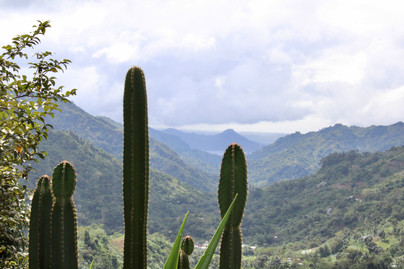
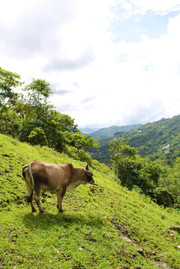
As someone who grew up in a small town with not much to do, I spent most of my time outside. I remember my sister always said that walking barefoot connected us with the trees and the Earth. So, as a true younger sibling, I copied her and didn’t wear shoes until I started school.
She would take me to the woods behind our house and we would spend hours playing games and searching for animals. We would sit in the creek listening for the birds (that the fairies were riding on, of course) and just wait there until my parents rang the dinner bell. Childhood curiosity is a beautiful thing and we all need to stay curious as Theanne Schiros stated at the end of her TED Talk.
I also noticed this childhood curiosity in Chapter two of Spineless when Juli Berwald talked about the children saw the 3 foot jellyfish on the beach. They were immediately curious about it and started by first touching, then pulling apart the jellyfish to see what the creature was made of. As an adult, I couldn't imagine doing something like this but, I think I would've had the same curiosity if it was me and my sister on that beach.
As I've grown up, I can feel myself becoming less and less connected with nature. I moved to a big city for college, I spend less time outside, more time on my computer, and I hardly ever explore anymore. It is natural to lose our childhood sense of wonder, but I think it is so important that we stay connected to our roots. This Earth has given us life, a home, water and food and we must have respect for our beautiful home. It is important to stay curious, learning about new things, exploring nature and asking questions. Curiosity is how we innovate and come up with solutions to the large waste problem that the fashion industry and the world is facing.
Bio-Materials
In the TED talk by Theanne Schiros, she talks about bio materials. Bio materials are materials that are made from living organisms such and plants or bacteria and can biodegrade at the end of their life-cycle to be recycled for the next generation. In this TED talk, Theanne discusses a material that comes from yeast and bacteria that are fed with just sugar and tea (known as kombucha culture). These bacteria are able to grow cellulosic fibers (that normally only plants can make). These cellulosic fibers pile on top of each other and form a thick mat that can be dried and used as a fabric.
In order to better the materials water resistance, Theanne's team looked to indigenous methods that were practiced by Native Americans. These techniques were able to make the material water resistant and 3 times stronger. It also made the material flame retardant (see below). After the flame didn't ignite, they continued to torch the fabric until it turned to ash, then within an hour, the material returned to its original form.

Another biomaterial is mycelium, a vegetative husk of fungi. this material can grow to shape. By feeding this fungi wood chips and corn stalks, they were able to grow a pair of baby shoes that they then stitched together with pineapple fibers from discarded pineapple tops. They were also able to dye the material using natural dyes to create the baby shoe shown below.

The next biomaterial that Theanne Schiros discussed was Algiknit which is created from kelp. Kelp is one of the fastest growing materials, they are able to absorb agricultural runoff and they act as a carbon sink. This means, they absorb a lot of carbon from the oceans, helping to limit ocean acidification caused by climate change. Watch the video I have linked to see how they create this fiber ! They are also able to apply the dye during the creation of the material eliminating the extra water usage during a typical dip dying process. They are able to knit garments to shape using this Algiknit which eliminates waste in the production phase. This material is also fully biodegradable so it can be planted in the garden at the end of its lifecycle.

Another thing that Theanne discovered with Algiknit was that it could be used with 3D printing. Using this 3D printed kelp, Algiknit and Grow A Pair teamed up to create a pair of sneakers that are fully biodegradable. These sneakers are flame retardant and water resistant, see below.

What Can We Do ?
But these new innovations cannot fix the industry alone. As consumers, we must begin to view our clothes differently. Many people go out shopping looking for a bargain, a sale, something cheap to wear on a night out with friends. I have done this before as well and it is a hard habit to break. If we begin to look at our clothes as an investment instead of something to wear once and throw away, we can help build this zero waste future.
I had a woman I was helping out at work (I work at a retail boutique in NYC) who came in looking for a hat and scarf. I brought her options and watched her mull over the decision for about 20-30 minutes. Now, some would say this is a long time to decide on a hat and scarf but I think if we are investing that much into our clothing, we should take a good amount of time deciding if we truly need the items. I do this with almost everything I buy, I am constantly asking myself, “Is this a want or a need?” and more often than not, it’s a want and by asking myself this, I avoid buying something I would later regret and end up never using. Although I also tell myself, “If I’m still thinking about it in a week or two, I can come back”.
This same women then asked me if I had a garbage bag and handed me her old hat and scarf to throw away. Obviously, I did not throw the perfectly good hat and scarf into the trash, but instead I brought them home to wash and donate (I actually ended up keeping the scarf because it's very cute). I got very angry after this interaction, this woman was so quick to just 'throw away' her old items that still worked fine just because she now had new items.
We need to get over the idea that new is better and that we must constantly be buying more and more items. Capitalism fills our world with constant advertisements, Times Square is a beautiful example of this. A giant tourist attraction built of only advertisements. We need to be able to ask ourselves the difficult questions in order to avoid inherent overconsumption.

Using the donut economics model (shown above) to show how we can become sustainable in the fashion industry is a beautiful and concise way to explain to both designers and scientists how to create products, while keeping in mind environmental and societal needs. We can learn from nature to innovative and create sustainable textiles using indigenous techniques and traditions. Our ancestors never wasted a thing, they could not afford to, when killing an animal they used every part of it. Which is something that has been lost in today's world of constant consumption.
The Possibilities
What else could be done with these innovative materials ? While watching this, I couldn’t help but think of the amazing possibilities of the materials. My dad is a firefighter and my sister was as well. When I was watching the blowtorch on this material, I thought of the ways this material could help when fighting the increasingly common forest fires that we are facing. Then when I saw the material repaired itself after, I was absolutely stunned. I had never even thought something like this was possible, but now I can’t even imagine all the possibilities.
Could this biomaterial be the answer to fighting the fires that are becoming more and more frequent due to climate change ? I always used to tell my dad I was going to fashion school to make him better fire gear. I’m not sure if any of you have worn fire gear, but it is incredibly heavy and so, so hot. When fighting fires, it is already considerably hot for the firefighters and the fireproofing on their jackets is made of harsh chemicals that can cause them harm. This new innovation could someday be used to create an all natural, lighter weight, and flame retardant clothing and shoes for our firefighters that is fully biodegradable.

Thank you for reading :)
-AJ
2/11/25
Sources:
Berwald, J. (2017c). If You Dare. In Spineless: The Science of Jellyfish and The Art of Growing a Backbone (pp. 17–40). essay, Riverhead Books.
“Nature makes exactly what it needs and doesn’t waste a thing” - Theanne Schiros


Comments